


Replacing Stair Half-Moon Treads: Pros, Cons and a Better Alternative
Are your stair half-moons or stair mats worn out and no longer looking good? Maybe they already looked that way soon after you bought them. There is an alternative that is easy to clean, doesn’t trap pet hair and can be wiped with a damp cloth. No more hassle with the vacuum cleaner, and still a perfect anti-slip solution for your stairs.
In this article (reading time about 5 minutes) you will learn how half-moon stair treads came about, how safe they are, how to remove them and what alternatives there are.
The Origin of Half-Moon Stair Treads
Half-moon stair treads first appeared in the 1960s. Interior fitters cut them from leftover pieces of carpet and finished the edges with needle and thread, or sewed a binding around them. That was much cheaper than the stair runner that was common at the time, which was held in place with brass stair rods. The half-moons were fixed with small upholsterer’s tacks and were especially popular in social housing.
The half-moon shape has a reason. Most Dutch staircases have treads that taper diagonally from wide to narrow. A rectangular mat doesn’t fit on such a sloping tread, but a half-moon does.
Today you can buy half-moon treads in all kinds of colors, qualities and sizes. A complete set costs just a few tens of euros. Most are about 60 cm long or shorter and are stuck to the middle of the tread, using a self-adhesive layer or a strip of double-sided tape.
The Dutch Staircase and the Walking Line
In the Netherlands, a staircase usually has 13 or 15 steps, depending on the year the house was built. Many staircases have a turn. On the inside of the turn, the tread is only about 12 cm deep, which makes it awkward to walk on.
That is why every staircase has an ideal walking line (today called the climbing line). It runs along the wall side, so you have the handrail to hold on to, and there the tread is deep enough to place three quarters of your foot flat on it. In practice, this is about one third of the tread length, roughly 30 to 35 cm measured from the outer edge. Most accidents happen when going down, because the treads aren’t deep enough.
In the past, little attention was paid to this. Space was scarce, so the stairs had to go up as steeply as possible, resulting in shallow treads. Since the new Building Decree of 2012, this has improved. A staircase now has 15 steps instead of 13, so it is less steep and the treads are deeper.
Is an anti-slip product still necessary on a new staircase? On stairs that meet the current Building Decree, an anti-slip product is less necessary for safety. Half-moon treads or mats are then mainly useful to protect the tread and paint from wear, or to dampen contact noise. That is actually their biggest advantage.
Half-Moon Stair Treads: Pros and Cons
Pros
Wide choice of colors and qualities
Great variation in prices
Suitable for all indoor staircases
Easy to replace
No contact noise and a pleasant feel underfoot
The walking surface of the stairs doesn’t wear
Cons
They get dirty quickly, especially on the part you walk on
Cheaper models come loose quickly and curl at the edges, creating a tripping hazard
Pet hair easily gets under the half-moons
Anti-slip performance is limited by the round shape
The half-moon sits in the middle of the tread, while you walk along the walking line. You therefore use only a small part of the half-moon, or you end up walking too much on the narrow part of the tread
Incidentally, an elongated stair mat is not suitable for sloping, shallow treads: it is simply too big. For sloping treads, you have to use the half-moon.
Removing Half-Moon Stair Treads
Half-moon treads or stair mats are usually easy to remove. They are often attached with double-sided tape, and with a little force you can simply pull them off. If that doesn’t work right away, warm them briefly with a hairdryer or an iron.
Remove glue or tape residue with a little sticker remover or WD-40.
If there is mounting adhesive underneath, carefully scrape it off with a paint scraper.
Then sand the treads smooth with a sanding block and 180-grit sandpaper, and repaint them in the color of your choice.
Replace Them With New Half-Moons?
Want to be done quickly, without painting the treads? Then fitting new half-moons is a perfectly good option for protection against wear and for safety. In that case, choose a stronger, slightly more expensive model, such as sisal half-moons. They are easier to clean and show walking marks less quickly. For a nice look, transparent plastic half-moons are also worth considering: on natural wooden treads, the color of the wood shows through. They aren’t cheap, but they look beautiful.
Combining is also a handy idea: an anti-slip strip on the heavily used stairs down, and half-moons on the attic stairs. Those are walked on much less, which suits most half-moons well.
The Alternative: An Anti-Slip Stair Strip
Are you tired of stair rugs, or do you find them unattractive or too expensive? An anti-slip stair strip made of soft Elastomeer mix is then the best and safest solution.
The luxury option: a strip in a milled groove. Have a carpenter or painter cut two small grooves with a total width of 34 mm in each tread, into which an anti-slip strip fits. After painting, you tap the strip into the groove with a rubber mallet. The result is sleek and elegant (the strip is only about 12 mm wide), but it isn’t cheap: milling costs €175 to €300 per staircase. In addition, the router can’t reach into the corner, so the strip stops about 10 cm short of the edge. And in a rented home you often aren’t allowed to mill grooves.
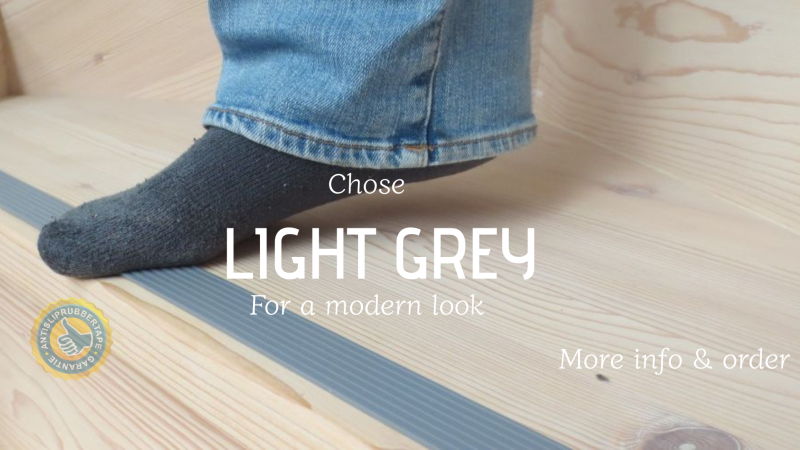
The smart option: self-adhesive anti-slip tape. A self-adhesive anti-slip stair strip has the quality of a strip, namely strong, thick and wide, but you stick it onto the tread yourself.
Very strong adhesive layer and optimal anti-slip, both in socks and in shoes
Can be applied over the full length of the tread, right into the corners, so also on the walking line
Easy to finish neatly: with special tools you can give the tape rounded corners, or cut it into two narrow strips for an elegant look
Easy to apply, even if you’re not very handy
Affordable: anti-slip tape starts at €20. A 15-meter roll, made specifically for stairs and enough for your whole staircase, costs about €60
Durable: a 100% Dutch product with a 2-year warranty
Various colors: the strip is available in 8 modern RAL colors. If you paint your stairs in the same color, the strip is less noticeable and you still have a safe staircase
Frequently read blog articles
Blog author: Guestblogger Simon van Eijk


Comments
Login to give reaction Your comment will be posted as soon as it is approved.