

Making Your Stairs Safer: How to Prevent Slipping and Falling
Have a steep or narrow staircase? Then you know how quickly things can go wrong, especially in socks or with wet shoes. Fortunately, you don't have to replace the whole staircase. With a solid handrail and anti-slip protection on your stair treads, you can make your stairs much safer in just a few hours. It's not a multi-day job: most homes only have 13 or 15 steps.
Why are old staircases so dangerous?
Many Dutch homes built before the war have a very steep staircase with narrow treads. The stairs simply had to be there, and safety was barely considered. As a result, accidents happen every year and people suffer serious injuries.
Usually, a staircase like this is built in between two walls. Replacing it is often not an option. What you can do is make the staircase safer with the right modifications.
Need more depth? Sometimes you can make the treads deeper by fitting an overlay tread over the existing one. This isn't possible with every type of staircase, so have it assessed first.
Step 1: Install a sturdy handrail
A good handrail on the wall side is the bare minimum. Keep these points in mind:
Choose a round handrail with a diameter of 40 mm. It sits comfortably in the hand and gives a good grip.
Mount the handrail securely to the wall. If your walls are thin or weak, first fit a board to the wall, glued and firmly screwed in place. Then attach the handrail to it using brackets.
Step 2: Make your stair treads anti-slip
Slippery treads are one of the biggest causes of falls, especially in socks. There are four commonly used solutions. All of them are available online from various suppliers.
1. Anti-slip rubber stair tape: the durable, neat choice
Anti-slip rubber stair tape was developed specifically for stair treads and is becoming increasingly popular. For many households, it offers the best balance between safety, appearance and lifespan.
Benefits of anti-slip rubber stair tape:
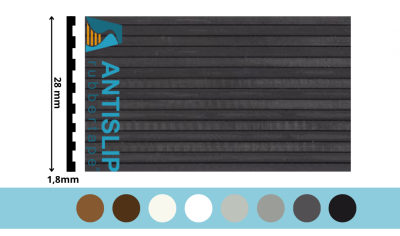
Extra strong and wear-resistant: made of PVC rubber, 2 mm thick and 28 mm wide. Your tread wears down less quickly.
Long lifespan: considerably more durable than standard anti-slip adhesive tape.
Easy to clean: no dirt that sticks.
Self-adhesive and quick to apply: you can do it yourself, with no routing or drilling.
Your choice of colour: available in 8 RAL colours, including the popular white RAL 9003. Our strips are produced to ISO 9001 quality standards, so the colours are consistent.
Stairs and strip in exactly the same colour: have your paint mixed in the same RAL code as the strip. That way the strip blends into your staircase, or choose a contrasting colour for extra visibility.
Please note: this anti-slip strip is only suitable for indoor use.
👉 View our anti-slip stair tape in 8 RAL colours
2. Anti-slip inset strip: sleek and permanent
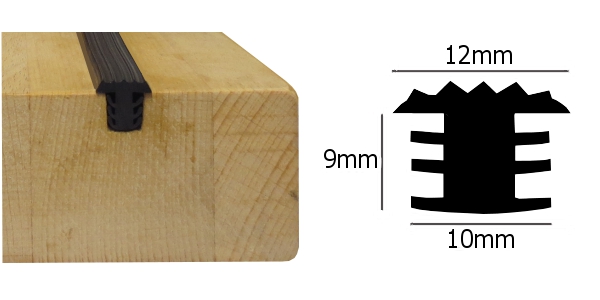
With an inset strip, you rout a groove of approximately 8 mm wide and 10 mm deep into each stair tread, and the strip is fitted into it. This gives a very sleek, permanent result.
Cost: if you have this done by a handyman company or carpenter, expect to pay around €175 to €250.
Order of work: have the groove routed first and paint the stairs afterwards.
Quality: cheap strips discolour and harden faster. A shiny, stiff strip is usually a bad sign.
Available: in various colours, from 1 metre lengths to rolls of 25 metres.
3. Aluminium corner profiles: quick and practical
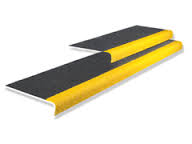
Appearance not that important, and you mainly want a robust solution? Then screw-on anti-slip corner profiles are a good choice. If you're reasonably handy, you can screw them onto each step yourself.
They are especially suitable if you often walk up and down the stairs with wet shoes. You can find them with yellow safety marking, with a rubber strip built into the profile, or with anti-slip grooves. DIY stores usually stock them in lengths of 1 and 2 metres.
4. Standard anti-slip adhesive tape: cheap, but not durable
Adhesive tape from, for example, 3M or IKEA is a perfectly fine temporary solution, but it has drawbacks:
Gets dirty quickly.
Curls up if the surface hasn't been properly degreased.
Feels rough on bare feet.
Pet hair sticks to it and is hard to remove.
If you want something that lasts for years, choose rubber stair tape.
5. Stair pads: not very practical
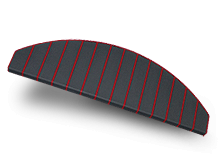
Stair pads (half-moon treads) come in many types, sizes and prices, including plastic and transparent versions. Fabric pads are easy to attach with double-sided tape, but they get dirty quickly and the cheaper ones tend to curl up, making the stairs slippery again. Plastic versions can be cut to size and stuck onto varnished treads.
Which anti-slip solution suits you?
Solution | Lifespan | Appearance | DIY-friendly |
|---|---|---|---|
Anti-slip rubber stair tape | Long | Neat, in RAL colour | Yes |
Inset strip | Long | Sleek, permanent | No, routing required |
Aluminium corner profile | Long | Industrial, robust | Yes (screw-on) |
Standard adhesive tape | Short | Basic | Yes |
Stair pads | Short | Varies | Yes |
Frequently asked questions
How do I make my stairs anti-slip?
Stick or screw an anti-slip strip onto each stair tread. Anti-slip rubber stair tape is the easiest and most durable way to do this yourself.
Is anti-slip stair tape suitable for outdoor use?
No, our rubber stair tape is only suitable for indoor use.
Can I get the strip in the same colour as my stairs?
Yes. The tape has a RAL colour code. Have your paint mixed in the same RAL code, and the stairs and strip will be exactly the same colour.
Which handrail is best for a steep staircase?
A round handrail of 40 mm, securely fixed to the wall.
Make your stairs safer today. Order anti-slip stair tape in your RAL colour and stick it onto your stair treads yourself in just a few hours.


Comments
Login to give reaction Your comment will be posted as soon as it is approved.